What should the observer report?
✂️ Callout builder
Cable decision card
Record the two clues before anyone touches a cable. The card keeps the final cut explicit.
The rule chooses a target colour; the order turns it into a physical cable position.
🔌 Wire cue: count → 💡 indicator → position + colour → ✂️ cut once → ✅ report the result.
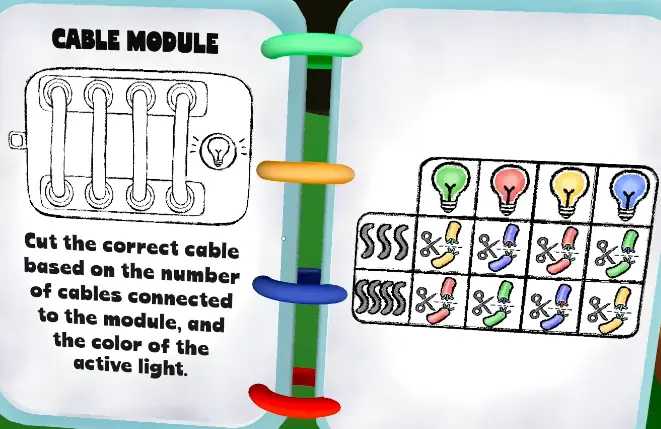
Report wire count, top-to-bottom position, color, stripe or solid state, and any LED or target indicator. Add position whenever two wires share a color.
Quick answer: how do you solve the wire module?
Count the wires first, read the indicator light, then describe every wire in order with its color and stripe state. The manual reader uses that complete packet to select one position; the operator repeats the position and cuts once. A color by itself is not enough when the panel contains duplicates, and a failed cut means the team should reread the current panel instead of reusing the old callout.
| Read this first | Why it matters | What the operator repeats |
|---|---|---|
| Wire count | Selects the correct rule branch | “Four wires” |
| Indicator light | Changes the lookup context | “Blue indicator” |
| Position and color | Identifies the physical target | “Third wire, red” |
| Stripe or solid state | Separates wires that look similar | “Solid red, not striped” |
| Result after the cut | Tells the team whether the state advanced | “Accepted / rejected / reset” |
How should the team confirm a cut?
The interpreter states the rule and exact position. The input player repeats it, cuts once, and reports whether the panel accepted the action. Use the puzzle index if the module is uncertain.
What does a real callout sound like?
Read the panel in a fixed order: number of wires, indicator-light color, then each wire from left to right. If four wires sit under a blue light, name every wire before choosing one. Say color and position together; “third wire, green” is safer than “green wire.”
| Field | Example callout |
|---|---|
| Count | Four wires |
| Indicator | Blue light |
| Positions | Green, yellow, red, blue from left to right |
| Decision | Cut the named color at its position |
| Confirmation | Operator repeats the position before cutting |
The common failure is remembering the color but forgetting the indicator light or wire count. If the first attempt fails, reread all three fields instead of repeating the same color.
What is the safest wire-solving sequence?
- Count the wires.
- Name the indicator-light color.
- Describe each wire from left to right, including stripe or solid state.
- Match the complete state to the wire rule.
- State the numbered wire and color together.
- Cut once, then report the result.
Never shorten “third wire, red” to “red” when two red wires are visible. If the panel changes after a cut, start a new count; do not assume the remaining wires keep their old positions.
Duplicate colors, stripes, and changing panels
When two wires share a color, identify them by position before discussing the rule. If the panel distinguishes solid and striped wires, say that qualifier in the same breath as the color. Do not describe a wire by where it was in a previous stage: after a successful cut, count and read the remaining panel again. The Module Solver can help with supported inputs, but it should receive the current observation packet rather than a guessed color.
The useful evidence from gameplay and manual screenshots supports this read order—count, indicator, ordered wire description, then one confirmed cut. It does not justify publishing a universal cut table for every possible panel state, so the live in-game manual remains the deciding source for the exact branch.
When should the operator stop?
Stop whenever the count, indicator, or wire order is uncertain. Ask the observer to repeat the state and the interpreter to confirm the rule. The Module Solver can help with supported module inputs, while the roles guide keeps one person responsible for the final call.
A safe wire callout
“Cable, left panel: four wires, blue indicator; green, yellow, red, blue from left to right. Confirming third wire, solid red. Cutting once.”
The phrase is intentionally complete. If the operator cannot repeat the same position and qualifier, the team has not reached an actionable answer yet.